The Ultimate Autistic Guide to Adulting: Career/Income II
Read Time: 14 minutes
Part 2: The Interview Process
Welcome back to the series. Last time we discussed the different types of employment. Now, you know the ins and outs of the different types of employment, and candidates decide what kind of employment is a best fit for you.
Before you can get a job, you have to go through the hiring and interview process. Oh, boy! Let’s talk about the interview process because for us autistic adults it is hell. The sweating in your borrowed suit, that’s 2 sizes too big. Trying to make eye contact without looking like a serial killer. Figuring out exactly what they’re asking you and how to respond without telling your whole life story. SERIOUSLY, I once had an interview where they asked, “tell me about yourself?” I literally interpret that question as a gesture to tell my whole life story. “Well, it started when I was born…” NO! Lesson #1, DON’T tell your whole life story. From my own failures and experiences, I am going to guide you through the interview process, learning what to do and how to come out on top—with a high-paying job that values your authenticity. I have over 10+ years of work experience from academia, corporate sector, non-profit, and even freelance. With over 1,000 clients hours of career coaching for my neurodivergent clients, here is the no-cost, step-by-step guide to acing the interview process.
In this article, we will:
Decoding the Interview: What Employers Are Actually Looking For
A Field Guide to Interview Formats
Preparation is Your Superpower: Your Pre-Interview Checklist
Steady as You Go: How to Navigate the Actual Interview
Curveballs: How to Answer the Hard Questions
To Disclose or Not to Disclose: That Is the Question
You Did It: What to Do After the Interview
Let’s begin:
1.Decoding the interview: What Employers are Actually Looking For
Employers are looking for a good fit. Someone who can quickly integrate into the culture of the workplace, transitioning into the job position, and complete a smooth transition into their specific team, department or field. The main objective of the employer is to ALWAYS hire a skilled employee(s) who can quickly meet performance expectations and build the bottom line–money, baby! This is where HR comes in. Human Resources (HR) is the department that is responsible for hiring, maintaining ethical standards/practices, and terminating (also handles resignations) employees.The people in charge of the hiring/interview process are called recruiters.
At the core of it, the interview process is where the organization 1) evaluates if you are a good fit:
Can this person complete the position(job) responsibilities? Can they do the job competently, without needing others to ‘hold their hand’ or ‘babysit them through the work’.
Does this person have a well documented and successful history of working in this position or similar positions?
Will this person be an asset to the company? Will they increase revenue? If I hire them, will there be a Return of Investment (ROI): If the time spent hiring, compensating, and employing this individual is financially beneficial where the company will increase sales, productivity, investment, and profit for substantial margins. AKA will we make money from hiring this person.
Unfortunately, for many of us autistic adults, the interview process is where our dreams come to die. We are often underemployed or unemployed. Part of that is because we don’t do well in the interview process. We often don’t make good first impressions. (see reference 1)
First, the hyperfixation of our special interest, lack of eye contact, stimming which is misread as hyperactivity or nervousness, and for many of us stuttering/communication challenges is read in corporate terms as “unhirable”. Second, we are often not good at social performance. Working within capitalist systems is all about the dance of social performance. Laughing at your boss’s unfunny jokes? Social performance. Standing around the water cooler and sharing surface-level information about your weekend? Social performance. Going for Happy Hour after work? Social performance. All of these experiences I just described would make any autistic adult go, but why? What is the point? How does this relate to my actual work? It doesn’t. It’s just social performance–being liked by your peers, being perceived as “sociable” and “I really know this person based on our morning conversations where Bob informs me about his children. We’re best friends”. It’s all a performance because none of this translates to actual, deep relationship building or explains how well someone does their job. However, if you are liked in the workplace, then you are visible, and visibility + being liked = promotions and increase your salary. (see reference 2)
It sucks, it’s unfair, but it’s the reality. So, the interview process (at its core) is really the first initiation of social performance. If you can learn how to play the game or create your own game, you will succeed.
WARNING: Fake job posts and internal hires. Watch out! Not all job posts are real or actual open for the public. Now that the internet is the main source of job hunting, scams have become a common problem. On many job search sites there are thousands of fake jobs mixed in with real ones. Fake or scam jobs are positions that do not exist. When you apply for the position, a scammer takes your information (often provided on your resume or when you fill out the application) and uses it for nefarious reasons. Also, although not a fake posting, there is a common practice of companies posting jobs that they already have an internal hire they plan to hire for that exact position. An internal hire is someone who already works for the company. Most companies prefer to hire internal candidates because they already know that person’s work history, ethics, and productivity. It simplifies the hiring process. However, what some companies will do is post the job, go through a whole interview process and then send external candidates an email such as, “thanks, but we have decided to hire someone who is a better fit for this position". The whole time they already knew who they were hiring and had no plans in hiring you! They post these positions because they have to follow legal requirements. (see reference 3) What are the red flags that a job is fake or going to an internal candidate? Download the infographic below.
2. A Field Guide to Interview Formats
Let's talk about the different types of interviews and how to successfully navigate them.
Phone/Video vs. In Person. The phone/video interview is set up by scheduling an appointment time with the recruiter. The recruiter will often send you an email with the details about the interview and sometimes a link to the video or to join the phone call. Phone/video interviews are less anxiety inducing than in person because you have control over the location, what you wear, and other environmental factors. In a phone interview you don’t have to worry about making eye contact, you can use a stim toy (no sound), or even use your autism Calm Kit. I always wear pajamas during my phone interview; it makes me feel very relaxed.
Now, in-person entails you driving or getting transportation to the interview location. Show up early (about 15-20 minutes before the interview; if you’re anxious like me I show up 30 minutes early just in case). Being late to an interview is one of the original sins. Just kidding. However, it’s important to not be late or let the recruiters know if an emergency comes up. Oftentimes the company will have you sit in the reception area. This is a good time to briefly review your talking points or do deep breathing exercises.
When it’s your time for the interview, the interviewer(s) will come get you and lead you to the interview room. Which is often an office. The interview will then be conducted within an estimated 45 minutes to 1 hour. Sometimes there will be multiple, consecutive interviews.
Panel Interview vs. 1-on-1. Panel interviews are when you are interviewed by multiple interviewers at the same time. They could be made of employees from the same or different departments or even a mix of directors/executives. The flow of a panel interview usually consists of a main speaker who will address you and give instructions. Followed by the other panelist who will ask follow up questions. Panel interviews can be intimidating, but what I tell my clients is to imagine you’re talking about your special interest to a group of peers. It removes the authoritarian factor. 1-on-1 is your standard interview format where you are meeting with 1 recruiter. 1-on-1 can be less daunting than panel interviews because you get the opportunity to focus on one person. Again, imagine you are talking to a peer (a professional peer), and just have an authentic conversation. The secret to acing the interview is to connect with that person.
Structured vs. Unstructured Interviews. A structured interview is where an interviewer asks the same set of pre-determined questions, in the same order for all interviewees. The interviewees are scored on their answers (confidentially) within a standardized scoring rubric. Structured interviews are often used in technical roles or used in large scale hiring.
An unstructured interview format is conversational, where the interviewer asks questions or communicates organically. There are no pre-set or pre-structured questions. I like this format because the conversation can flow naturally. It’s like your having a coffee chat with a colleague.
Skill Based or Task/Trial Interviews. This interview format is a little more autistic-friendly because it's focused on completing a task rather than social performance. A skills based or task/ trial interview is where you solve a problem (or complete a task) that is related to the position. That could be answering a few hypothetical questions on what you would do for different workplace scenarios. Or creating code to execute a specific function. One thing to look out for is to make sure you are not doing free labor for these companies. This should be a few minutes or less than an hour assignment. If you are asked to create a whole program or project, for multiple hours, and are not being compensated. RUN!!!
3. Preparation is Your Superpower: Your Pre-Interview Checklist
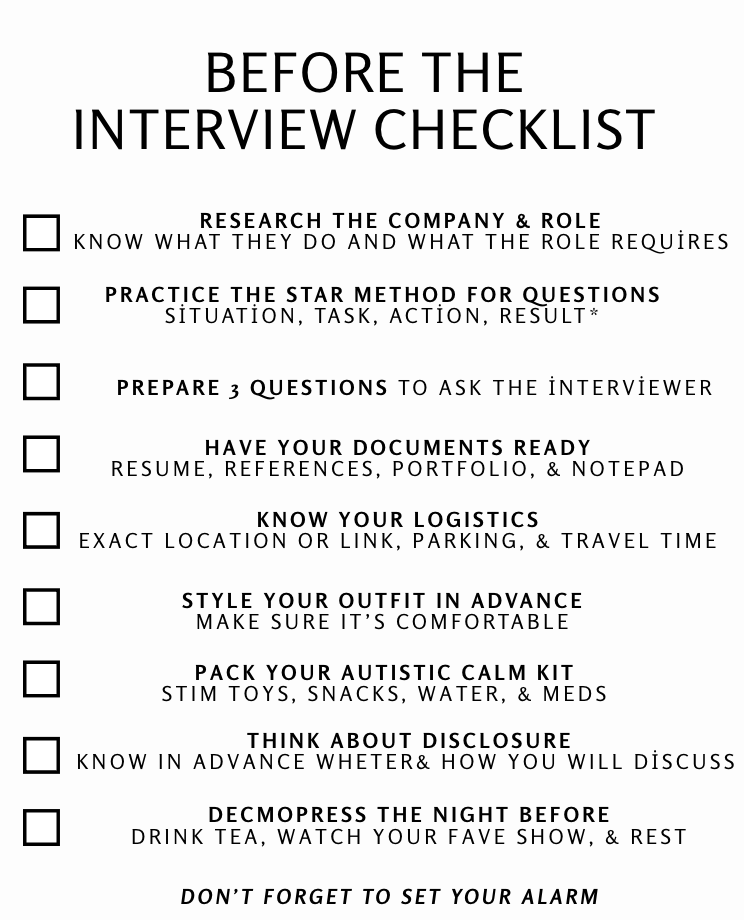
The Autistic Adult Checklist Pre-Interview
*What is the STAR method? This is a technique to answer questions by detailing a specific SITUATION, TASK, ACTION, AND RESULT. For example, if you are asked, “how did you handle a difficult situation at your past job?” You will first discuss the situation: “I was directed to work on a project with a difficult co-worker”. Then, talk about the task: “we were tasked with creating a portfolio and presentation for our clients”. What was your action plan? “we split the project into two parts and I worked on the presentation section”. Finally, what was the result?: “because we split the project and I was able to focus on my strength, presentations, our clients were thrilled with the presentation and they renewed their contract”.
4. Steady as You Go: How to Navigate the Actual Interview
Let's talk about what to do during the interview. You will meet the interviewer(s) either in-person or virtually (via phone or video). Here is a progression of what to do throughout the interview progression:
Greet the interviewer. This can be a short, but firm handshake. A “how are you doing, today”. Or anything that feels natural to you. I like to throw in, “I’m excited for this interview” because I’m one of those enthusiastic autistics.
The eye contact dilemma. If you’re in-person, here’s a trick if you are worried about making eye contact: Don’t stare them directly in their eyes. You’ll get lost in there! Instead, look at the space between their eyes. You want to look for 2-3 seconds, nod your head, and look away. If you’re doing a video interview, here’s another trick: stick googly eyes near the camera. That way you can look at the googly eyes, while you are talking into the camera. Now doing all of this takes too many spoons, in my opinion. Just be yourself. If they are bothered by the lack of eye contact, it’s not the place for you.
Take your time answering questions. We tend to rush our speech and slur/mix-up our words when we are excited or anxious. Before you answer a question, take a 2-3 second pause. Then begin. There is no rush. You want to make sure your communication is clear. If you get stuck or start to stutter, take a deep breath, and start over. Say something like, “I got so excited about this question, let me take a step back and reiterate what I said”.
Stim away! Stimming helps us to regulate our bodies. If you tap your feet, or click your fingers, or rub your hands along the chair, do it! As long as you are not making big, exaggerated movements (and even if you are–it’s not the end of the world), you will be okay. If they can’t handle you at your stimming, how can they handle you at your brilliance?
The balance between masking and authenticity. Interviewing is a high-masking event because it's a social performance. Be compassionate with yourself. If you don’t perform the way you or others expected, it’s okay. A job is important, but at the end of the day an interview is just that, an interview. You are what’s the most important.
At the end, your interviewer may ask you if you have any questions. This is when you pull out your 3 questions from the Pre-Interview Checklist.
Thank the interviewer for their time. They will discuss next steps with you and now you can get out of there! You did it!!! I’m so proud of you!
5. Curveballs: How to Answer the Hard Questions
-
Why It’s Tricky: Answer too high and you might price yourself out. Too low and you undersell yourself.
Action Plan:
The night before the interview, research the average salary for the position or a similar position in your area (use Glassdoor, Indeed, or the Bureau of Labor Statistics)
Give a range rather than a number. Make sure your ideal number is at the lower end of the range you give.
If you don’t know, it’s okay to turn the question around
Example Answer: "Based on my research and the responsibilities of this role, I'm looking for something in the range of $X to $X. That said, I'm open to discussing the full compensation package."
-
Why It’s Tricky: Too honest and you look unqualified, too vague and you look like a liar.
Action Plan:
Choose a real weakness that is NOT a core requirement of the job.
Always follow-up with what you are doing to improve yourself.
Example Answer: "I sometimes struggle with asking for help when I'm stuck because I prefer to problem-solve independently first. I've been working on this by setting a personal time limit . if I haven't found a solution within a set amount of time, I reach out for support."
-
Why It’s Tricky: I hate this question! There’s a gap because we are HUMAN and life happens. However, recruiters see gaps as a weakness, while not taking into account illness, burnout, etc..
Action Plan:
You do NOT have to over-explain or disclose your diagnosis (neurodivergence and/or mental health).
Be honest and brief. Then pivot into how you are ready now or what you have learned.
Gaps for caregiving, health, education, or personal growth are all valid!
Example Answer: "I took time away to focus on my health and personal development. During that time I was able to [learn a skill / volunteer / reflect on my career goals]. I'm now fully ready and energized to bring my focus back to work."
-
Why It’s Tricky: They are fishing for red flags about your personality, temperament, and social skills.
Action Plan:
Use the STAR Method.
Choose a low-stakes example.
Focus on the resolution and what you learned (NOT the drama).
Avoid speaking negatively about the person.
Example Answer: “In a previous role, a coworker and I had different approaches to a shared project and it created some tension. I requested a one-on-one conversation to align on expectations and we were able to divide the work in a way that played to both of our strengths. The project was completed on time and we worked together more smoothly after that."
-
Why It’s Tricky: Who knows what will happen in 5 years? Especially now, we might all be drafted for WWIII. Maybe you’ll be planning to leave this job for a better one.
Action Plan:
You don’t need a perfect answer . They just want to know that you are motivated and not just passing through. (even if you are—shhh!)
Connect your answer to grow with the field or company.
Example Answer: "In five years I hope to have deepened my expertise in [relevant skill or area] and taken on more responsibility within a team. I'm genuinely interested in growing with a company where I can contribute long term and continue to learn."
6. To Disclose or Not to Disclose: That Is the Question
At the end of the day, disclosure is up to you. My personal opinion: based on my 10+ years of experience in disability support, academia, and the corporate world, I say don’t disclose before or during the interview process. Unless, you are applying to a job that specifically states in their values or who they support (like a non-profit organization run by and for neurodivergent adults) that they are neuro-affirming. I hold this opinion because I have experienced myself and seen countless clients get rejected or experience workplace discrimination. Under federal law, due to the Americans with Disabilities Act (ADA) it is illegal to discriminate against someone because of their disability. However, legality does not equal reality. We live in a capitalist society and a history of colonization has left a legacy of ableism. Discrimination in the workplace happens, everyday. To be on the safe side, I say disclose when you have that contract signed and after you have submitted your accommodation request to HR. Whether you disclose or not, both choices are valid.
7. You Did It: What to Do After the Interview
Congratulations! You made it! Pat yourself on the back. Do a little dance because you really did that! Here’s what to do after the interview:
Treat Yourself! Go get a celebratory ice cream or take a walk in a park. Whatever makes you feel good, go do that!
Use your Calm Kit. If you are feeling low on spoons, tired, or even falling into an autistic meltdown or shutdown go ahead and use your Autistic Calm Kit.*
Forget about the interview for the next 6 hours. Don't think about the interview or do any interview related for the next 3 to 6 hours.
Send a thank you note. Within 24 hours of your interview, send via email or mail (if available) a thank you note to the person(s) who interviewed you. You can keep it short and sweet. Thank them for their time, reflect on how you enjoyed talking about XYZ, and that you look forward to hearing from them. A thank you note can make the difference between a “thanks, but we went with someone else” to “congratulations, you got the job”. You can ask the interviewer before or at the end of the meeting for their email address. If you don’t have that information, you may have to do some research on Linkedln or the company’s website.
The interview process is challenging and intimidating. Especially, when you’ve never been taught the secrets about the process. Here, I’ve shared my knowledge on how to navigate and succeed in the process as an autistic adult. Based on my own past failures, experiences, and my work with my clients I’ve created an ultimate guide that you can use to help you through every step of the process. You’re not alone and you deserve to be employed in a workplace that respects your individuality and time. You deserve to be paid well, live a balanced, comfortable life, and enjoy yourself. If a company won’t hire you because of your lack of eye contact or stimming. Guess what? You deserve better!
If you’re feeling stuck or overwhelmed in your job search, you don’t have to figure it out alone. I offer career consulting specifically for neurodivergent adult. Supporting you through everything from identifying aligned roles to navigating applications, interviews, and workplace communication.
Book a session to build a job search strategy that actually works for you.