The Ultimate Autistic Guide to Adulting: Career/Income I
Part 1: Types of Employment
Content
Freelance/Independent Contractor
Like me, when you were born, the doctor didn't hand you the guidebook to adulting. If you're confused, I understand because neurotypicals all seem to have gotten this guidebook. At least in our perspective, they seem to be handling adulthood pretty well. So, if you are a late-diagnosed autistic person, or an adult with ADHD, or any of the many neurotypes that make up the neurodivergent umbrella, then you're in the right place.
You went through life or are going through life, dazed and confused. Constant miscommunication, confusion about milestones, challenges with adulting. The whole 9 yards. So, at 2am you find yourself scrolling through the web, searching for “Am I autistic?” or “What is autistic burnout?”. You landed here and guess what? You’re in the right place!
Welcome, fellow resident aliens [If you haven’t watched the show Resident Alien, you need to, it will change your life!]. Like you, I've been through the ringer of trying to understand my existence and connection to the world. After many years of lived experience through my late-diagnosis as an AuDHD woman and integration of my 10+ years of professional experience in sociology, psychology, disability support, consulting, coaching [and the list goes on and on because the AuDHD brains has to try EVERYTHING], I created the Ultimate Autistic Guide to Everything Adulting. Information about adult neurodivergence experiences is almost non-existence [we stop existing after childhood, obviously] and inaccessible, filled with complicated academic jargon. This is where I come in! I am a neurodivergent educator and systems management consultant. What I do is translate those complex scientific facts into easily digestible infographics, blogs, and other educational content. Information that makes you go, “Oh! That’s what that’s called” or “Wow, that’s why I behave this way”. Yep, it’s science!
Join me on this journey as we discuss many topics related to autistic adulthood ranging from career to dating, and everything in between. If you've been feeling like a failure, confused about your next steps, are ready to step into a more confident version of yourself, let’s go!
The first stop on our journey is the Ultimate Autistic Guide to Career and Income. The foundation of adulthood is making money. Money makes the world go round and it allows us to buy the things that bring us autistic joy. In order for us to make money, we have to receive income or have access to it. For many of us, the answer to making money is employment.
In this article, we are going to talk about different types of employment. We will define each type of employment, measure employment and its impact on autistic adults through 5 metrics:
Autonomy Level (how much control over schedule/tasks)
Accommodation Ease (how hard is it to get what you need met or supported?)
Income Stability (predictable vs. variable)
Social Demands/Masking Level (how much masking/peopling is required)
Energy Management/Executive Function Load (which types allow for better management of autistic burnout, navigating executive functioning, etc.)
Energy Management/Executive Function Load (which types allow for better management of autistic burnout, navigating executive functioning, etc.)
We will then look at pros and cons, including examples. This guide is to be used for educational purposes only. It is designed for all neurodivergent adults who want to understand employment.
Let’s begin.
Full-Time Emplyment.
Full-time employment constitutes an individual working 30+ hours a week. A full-time employee will often receive job benefits, such as
Health insurance
Vacation time and paid time off (PTO)
Retirement plans
And many more benefits or less, depending on the company. If you're a full-time employee, you are probably going to be receiving a W-2 form. This is a form that your employer fills out and sends to the IRS confirming your full-time employment status and your income. We’ll talk about this in the Taxes Guide article.
Autonomy Level: In full-time employment, you have low-medium autonomy; unless you’re the boss. With full-time employment there are often strict rules, and guidelines one must follow (including unwritten rules that everyone expects you to know!). Also, if you are working on a team or project, you will be expected to give updates, speak with your team, and check-in with your project manager. In some places management micromanages your time–clocking your work hours and even in extreme cases dictating your break time. [Personally that level of micromanaging makes my autistic soul die inside 10 times over]. Again this all depends on your work environment which can be different for each field, company, and even department.
Accommodation Ease: Lucky for us we live in 2026 [or maybe not], but as of the time of this article workplace accommodations exist. Many employers have a process for workplace accommodations. In many jobs accommodations and the accommodation process can take a long time [3-6 months; depending on the time of year you submitted your form] so you want to get that process moving early.
Income Stability: Income stability for full-time employment rates high to very high. One of the pros of full-time employment is the consistency and stability an individual can have. However, like all jobs you are replaceable, and a company will fire you when it comes down to their bottom line. Be it the CEOs next private yacht or to save the company money, they will fire you. Take this as a nudge to remember:
"You are worth more than what you can produce. You matter because you exist. Your loyalty lies within yourself”
Social demands/Masking: The social demands for full-time employment is medium to high. It depends on your work environment, the company you work for the department you work for your team, and other factors. For example, someone who works full-time in tech and works remotely only interacting with clients and speaking with management periodically through meetings is going to have a lower social demand than someone who is working as a full-time sales rep at a start up. When you put in 30+ hours of work, plus unpaid socialization labor such as after-hours meetings, work parties, and other social events there's a lot of masking that's going on. For neurodivergent, especially autistic adults masking is when we change our behavior, personality, and identity to fit into the environment that we are in. Masking costs a lot of energy.
Energy Management/Executive Function Load: Working a full-time job takes a lot of energy for most of us neurodivergent folks. For many autistic individuals full-time employment is not achievable, or leads to burnout. Autistic burnout is severe fatigue and physical, mental deterioration due to stress, over exertion, and sensory overload. To truly manage one's energy working a full-time job an individual needs to set clear work- life boundaries. This includes clocking out when you are contracted to (no overtime!), taking your lunch break, and learning to say no, when applicable.
Executive function load is extremely high in this work type. Executive function is the ability for one to process, think and perform other neurological functioning. For many neurodivergent adults we experience executive dysfunction, which is the inability or delay in professing information. Working 30+ hours puts a lot of load on the brain, so if you are already dealing with time management, organization challenges, and brain fog, working a full-time job is going to exacerbate those challenges. Which can lead to autistic burnout and even early resignation/termination. If you're someone who is currently dealing with executive dysfunction in the workplace, you will need to make sure that you have a really thorough plan and support team (like me!) to help you navigate the workspace. When you're in burnout, the goal is to create balance and joy, rather than focusing on promotion or productivity.
Pros of Full-Time Employment:
Stable income
Health insurance and benefits
Paid vacation and sick leave
Career advancement opportunities
Cons of Full-Time Employment:
Less flexibility with time
Work-life balance can be harder
Fixed schedule
More room for burnout, masking, and executive dysfunction
Common fields: healthcare, corporate offices, tech, engineering, education.
Part-Time Employment.
Part-time employment is employment that is less than 30 to 40 hours per week.
Often with part-time employment you do not have the full benefits that a full-time employee would receive. While a full-time employee would be paid a salary, part-time employees are usually paid with hourly rates. Part-time employees receive a W-2 form, unless they are an independent contractor, which we will talk about soon.
Autonomy Level: The autonomy level for part-time employment is mid-high depending on the workplace environment and other factors. Depending on your employer you may be able to set your own hourly work schedule.
Accommodation Ease: Similar to full-time employment, part-time employees are also entitled to accommodations under the Americans with Disabilities Act (ADA). However, whether you receive full, partial, or no accommodations is up to your employer. [See accommodation article for more information].
Income Stability: Let’s do some girl math:
You are a full-time employee and you are paid an annual gross income [before taxes and other deductibles are included] of $65,000/yr. This is a fixed amount you receive regardless of hours worked or other factors.
Now, you’ve been dealing with autistic burnout and decided to go part-time at the same company. Now, you are being paid hourly wages. Your current pay is now $30/hr. Last week you worked 20 hours, so you will get paid for that week $30 x 20 hours = $600. This week you work 15 hours, you will get paid $30 x 15 hours = $450. Your payment often fluctuates and is not as consistent as salary payment.
Social Demands/Masking: This factor depends on your environment. If you are working in a high impact environment [client forward positions, call centers, hotlines, etc.], then working part-time is going to have a high social demand and requires more masking from you. If you're working in an environment that is focused on more long-term projects, with set deadlines and more structure, then social demands will be less.
Energy Management/Executive Function Load: For neurodivergent employees, part-time allows for better and more efficient energy management/executive function load. Many autistic adults find themselves working part-time due to autistic burnout, executive dysfunction, and other disabilities. Working less hours means there is less emotional and cognitive load that one has to manage. This allows for more work-life balance and focus on managing one’s health.
Pros of Part-Time Employment:
Flexible schedule
Good for students or parents
Good for autistic burnout or those who are disabled/chronic disability who still need to make income
Less stress from long hours
Cons of Part-Time Employment:
Lower income
Often fewer or no benefits
Less job security
Common fields: retail, restaurants, tutoring, customer service.
Freelance/Independent Contractor
Freelance and independent contractors are two different, yet similar self-employment types. We're going to group them together.
A freelancer is a self-employed worker who commissions their work to a client.. They can work with multiple organizations, contractors or individuals, simultaneously. Freelancers decide their own pay rates, schedule, work hours, and who they want to work with.
An independent contractor provides goods, labor, or services to a business under a temporary contract. They may work with many clients or decide to work on one big project. An independent contractor is NOT an employee. An independent contractor sets their own pay rates, decides when to work on a project, and can also decide who they want to work with.
As a freelancer or independent contractor, you are going to pay self-employment taxes (15.3% of your income) to the IRS through the Schedule C (Form 1040) [you’ll learn more about this in the taxes article]. Payment received from clients will be reported to the IRS on Form 1099-NEC. You are responsible for all tax payments, meaning that your client will not be paying any portion of your taxes to the IRS, the responsibility is on you.
Autonomy Level: As a freelancer or independent contractor one's autonomy level is quite high. You get to decide the how, when, where, why, and what you do. You set your own prices. You set your own schedule. On the other hand, you are literally responsible for EVERYTHING that includes taxes, meeting deadlines, and the outcome of a project.
Accommodation Ease: Accommodation ease is high as a freelancer/independent contractor. You get to set your own accommodations: when you where, how long you work, when you take breaks, the environment you work in, etc. Also, if a client is not willing to adjust to your accommodations, you get to decide if working with them is a good fit or not.
Income Stability: Self-employment initially is not as stable as full-time employment. Self-employment comes with high and low seasons–where sometimes one month you could be making $6K, another month $3K, and the next month nothing. Your first few years might include low client load, low pay, and inconsistent income. This is why it's so important to plan ahead when you're self-employed. The months with a surplus of revenue, is the best time to save money for those low paying or no income months. Also, remember to put away some money for taxes. Don't forget the taxes because the IRS NEVER forgets the taxes. You will have to pay a self-employment tax of 15.3% of your income, which is paid quarterly to the IRS through Form 1040-ES. We’ll discuss this more in the taxes and employment article.
Social Demands/Masking: Social demand and masking is low-medium levels. You decide how and when you socialize. Being self-employed leaves for you to be authentic with your delivery of services and how you want to market yourself.
Energy Management/Executive Function Load: Energy management and executive function load depends on how much work you are putting in. Remember, as someone self-employed there is no boss or manager to manage your work; that’s all up to you. There might be specific deadlines for a project, but when and how you complete it is up to you. Many of us neurodivergent adults fall into two extremes: 1) either we work 40+ hours a week due to perfectionism OR 2) we ‘procrastinate’ [it’s not laziness, it’s time blindness—the ability to accurately estimate how long it takes to complete a task. Neurodivergence is the gift that keeps on giving!] and completes everything last minute; which often leads to burnout.
What helps to disrupt these patterns is to create a balanced and consistent system:
“Science time: Your brain does not differentiate between a concrete deadline set by a client and a fake deadline set by you. It just knows DEADLINE. You can trick your brain into completing a deadline by creating mini deadline due dates. Let’s say I have a project deadline for a client that is due in 6 months. I can break that deadline into 2 mini deadlines: 1) project outline due in 2 months and 2) project completion in 4 months. This way I will have my deadline set for 4 months, which is 2 months before the actual client deadline. By the time 4 months come up, you will have your project completed or give yourself 2 months to complete, rather than waiting to last minute.”
Pros of Freelance Employment:
High flexibility (choose when and where to work)
Potential to earn more per project
Choose the clients or projects you like
Cons of Freelance Employment:
Irregular income
No employer benefits
Must handle your own taxes and insurance
Common fields: writing, graphic design, programming, marketing.
Pros of Independent Contracting:
Often higher pay than a permanent job
Opportunity to gain experience quickly
Flexible between contracts
Cons of Independent Contracting:
Job ends when the contract ends
Limited benefits
Less long-term stability
Common fields: IT, construction, consulting, project management.
WARNING: Employee Misclassification.
Watch out. Pay attention. This was a hard and painful lesson I had to learn on my own. I'm sharing my story so you don't have to go through the same exploitation and undervalue that I went through. There are companies and organizations that will hire you as an independent contractor when you should be classified as an employee. This is illegal. They know that they have misclassified you, but exploitation is the goal. This means that you don't get any of the benefits of full-time employment or part-time employment, you're literally not considered an employee and therefore you have to pay full self-employment taxes. When tax season comes around, you will be given a 1099-NEC rather than a W-2 form.
This is a common occurrence in the gig economy—which is short-term, often virtual work that relies on freelance such as rideshare companies, tech companies, or online coaching and therapy platforms. If you can, I would say stay away from these companies all together. However, if you are already in this situation I will provide links on what you can do next.
This is super serious. I was being exploited in a position where I misled about my pay rate, scheduled hours, and was being extremely underpaid for my expertise. I was making below poverty wages providing my expertise to Fortune 500 companies and leadership. That’s not okay! We deserve better!
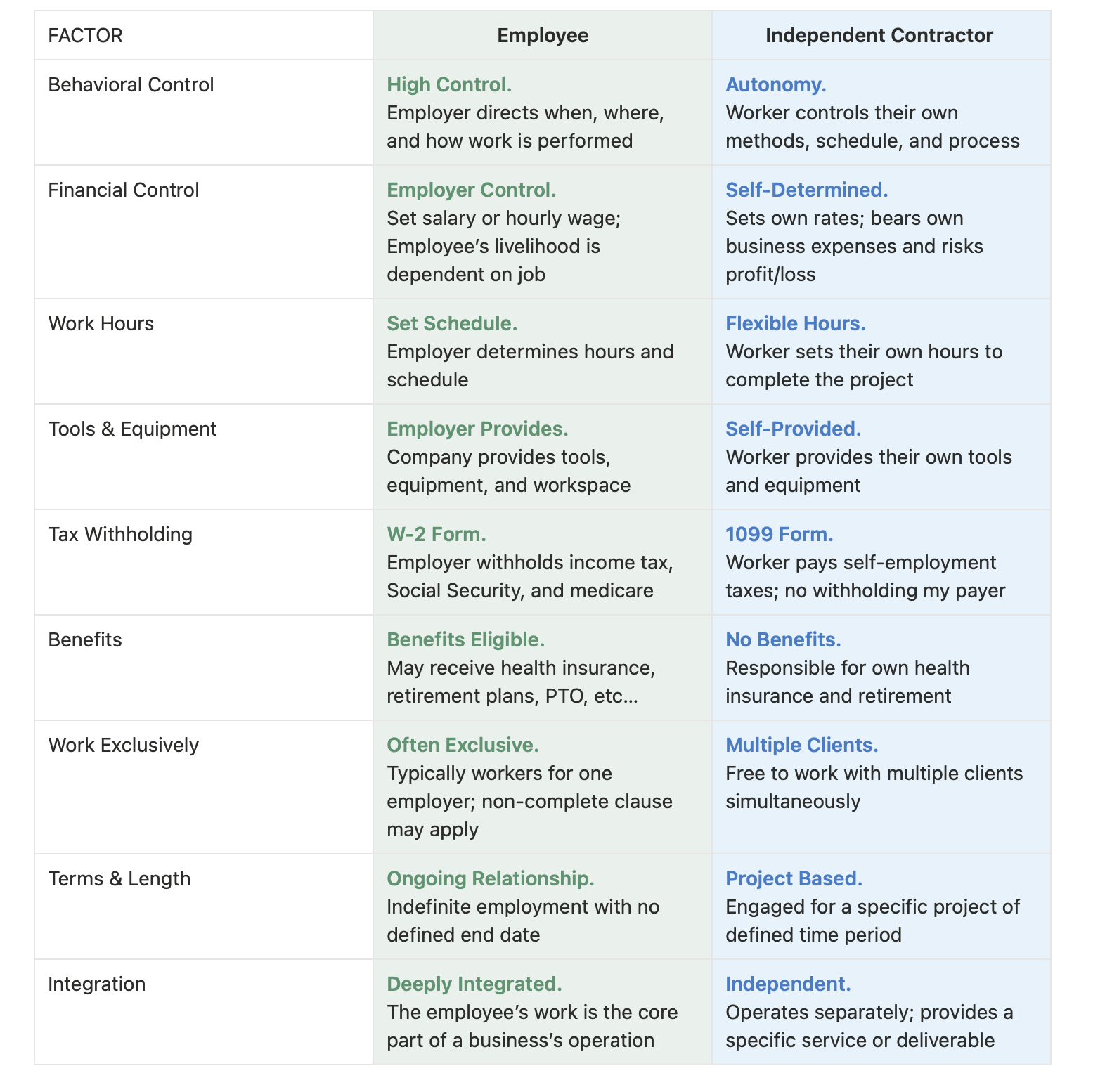
Employee vs. Independent Contractor Comparison Chart
Self-Employment/Entrepreneur.
Our final type of employment is self-employment/entrepreneurship. This is when someone owns their own business and sells products, goods or services to clients.
The metrics are the same as the freelance/independent contractor section. Refer back to section.
Owning your own business is hard work. There is a misconception that entrepreneurship means fast money or passive income. It does not. It takes immense perseverance, consistency, and patience to make a livable income or passive income. From the start of a business launch, it takes 9-12 months for that business to start to see profit; especially for a virtual business.
Over 20% of businesses fail within their first two years and over 50% fail within five. Yet, there are some really great pros that make business ownership worth it.
Pros of Entrepreneurship
You’re your own boss
Set your own schedule and work environment
Full creative control of your business
Cons of Entrepreneurship
Have to market your products & be comfortable with visibility
Everything is determined on you
Takes a few months to years to build a loyal client-base
Common Fields: Small business owner, start-up owner, merchandise seller, boutique owner, consultant
There you have it people, an in-depth look at the different types of employment. This list is not all-inclusive, but it covers the main types. For us autistic adults, employment can be complex and strange, with its unwritten rules and expected norms, but as we continue this journey you will be equipped with the understanding of how to navigate employment and find/create systems that work for your brain. Having this knowledge will equip you with the tools to command equitable employment.

Summary Table Work Type
The first step to getting a job is filling out the application process, navigating the interview and negotiating your salary. This is what we will be discussing in the next article. See you soon!
Resources:
If you’re feeling stuck or overwhelmed in your job search, you don’t have to figure it out alone. I offer career consulting specifically for neurodivergent adult. Supporting you through everything from identifying aligned roles to navigating applications, interviews, and workplace communication.
Book a session to build a job search strategy that actually works for you.